


Astrid Korporaal: What is the importance of exploring an intergenerational dynamic for you? It is a key element in this film, but also in some of your previous works.
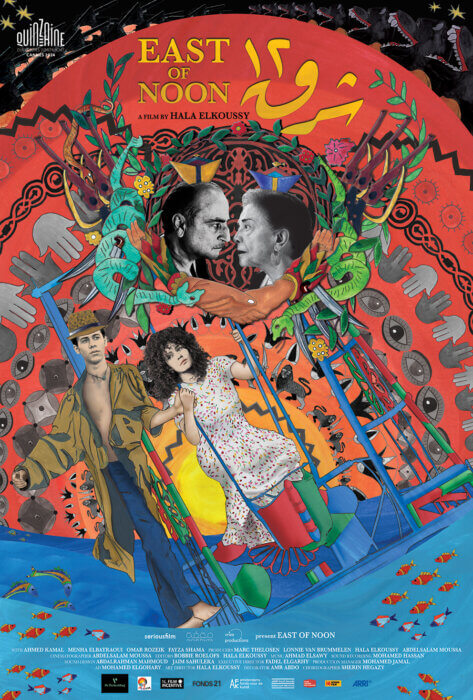
Hala Elkoussy: On a personal level, it comes from the fact that I have a growing child who’s now approaching the age of the actor in this film, but I’ve always had a young voice in the work, carrying a torch for the future. It’s not like I’m looking back at my younger self: I’m rediscovering what it is like to be young, through his eyes. In general, I think we don’t value youth enough, despite the fact that the most important things throughout history happened because of their unchained energy, which does not measure consequences. In the Arabic tradition the storyteller always tells us about young men and women, their quest for the good and their fight for what is right. In many poor countries, most of the population is young. In Egypt, half the population are under the age of 21. We have an Arabic saying: the future is theirs.

AK: What made you want to move into the film world, as an artist?
HE: My first thought of making a film was in 2007. I wanted to reach more people without an intermediary. By this I mean the museum or gallery, but also artistic language. It can be so sophisticated that it’s only privy to people who are in the habit of going to museums. In my mind, film is the most democratic of all artistic expressions because it has enough in it to live on without anyone to explain or contextualize it. So, I made my first attempt in 2010, and then I received support from the Hubert Bals fund. I also won the Abraaj capital prize as an artist, so I felt I had achieved what I wanted to achieve as an artist. When I screened Cactus Flower (2017) for the first time, I felt that I was right. It’s a great feeling every time you sit in a different theatre with different people and their different reactions. You feel like the film comes to life.
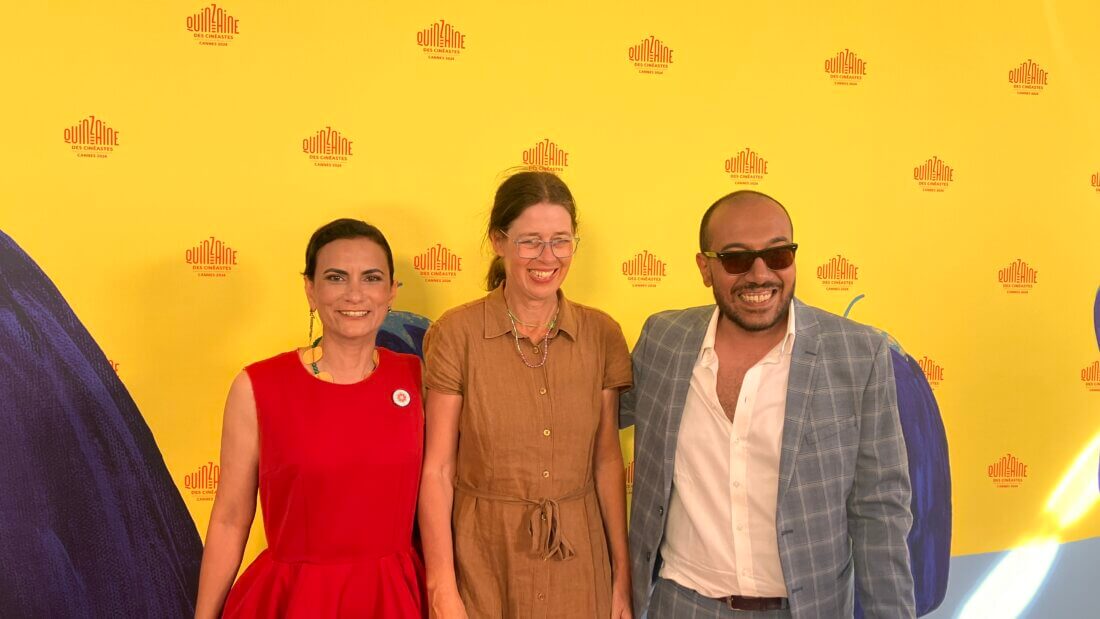
From left to right: Hala Elkoussy (director), Lonnie van Brummelen (producer), Abdalrahman Mahmoud (sound designer)
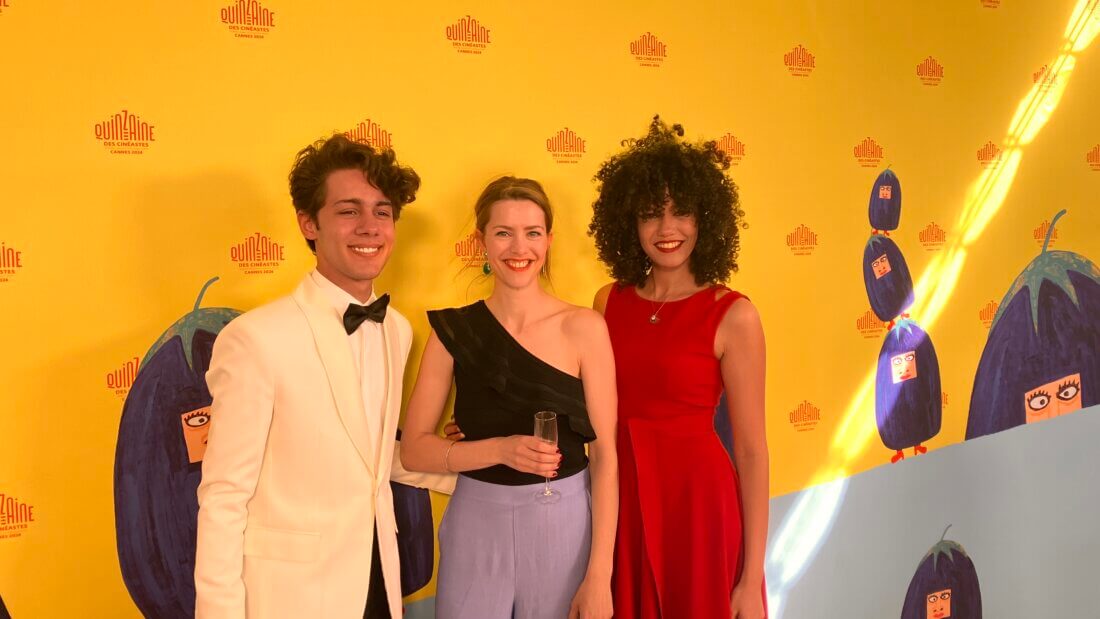
From left to right: Omar Rozeik (actor), Bobbie Roelofs (editor), Fayza Shama (actress), photo’s taken at the premiere of East of Noon at Quinzaine des Cinéastes, Film Festival Cannes by Siebren de Haan
AK: How does the film tackle the danger of art being appropriated by power?
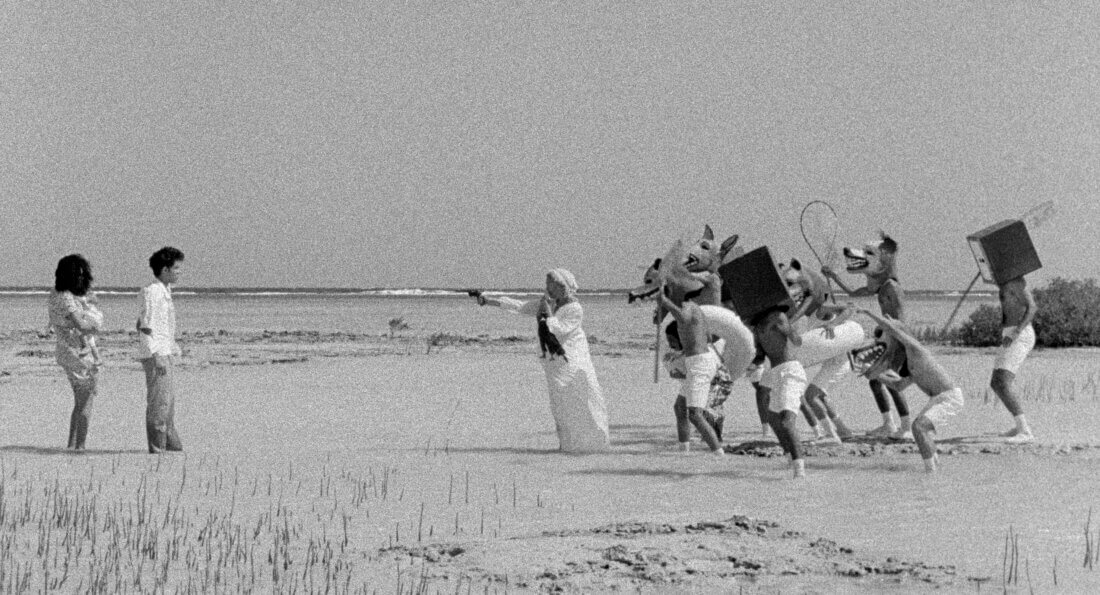
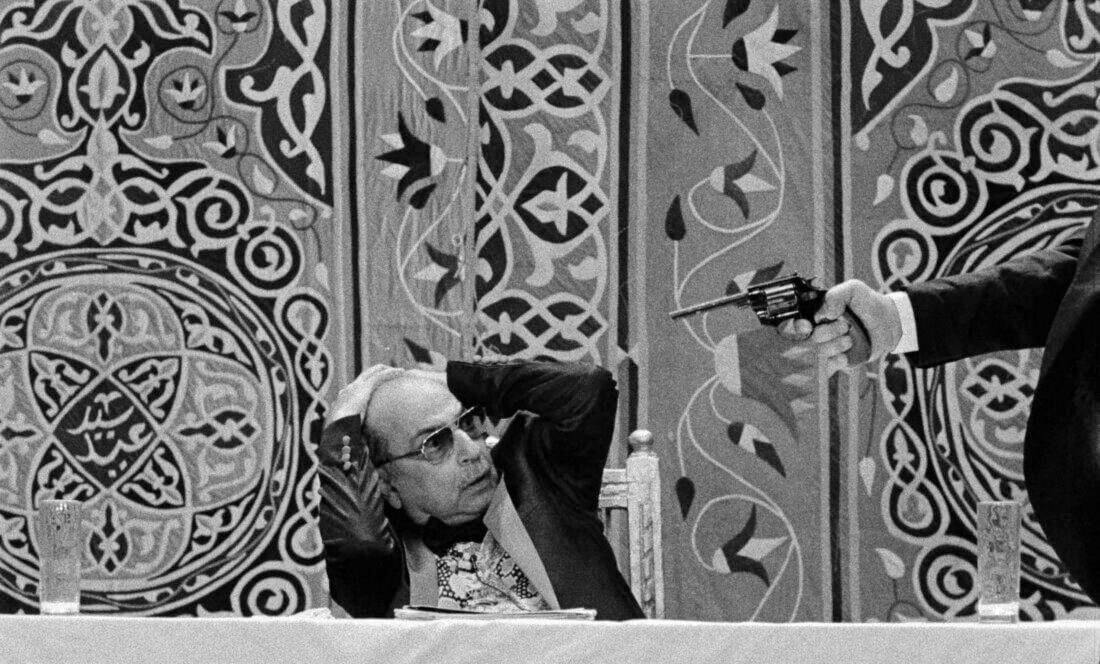
HE: When I first started thinking about the film, I was asking myself, why am I here? The world right now is not a very good place. I thought that as artists what we do has so little effect that we assume it is not harmful. We are not in service of the state, we are not producing propaganda. But we could also say that by continuing to produce these un-harmful products, we are actually supporting the situation. In the big sea of entertainment that this our work ends up in, culture is not necessarily conducive to making people look at more serious issues in the here and now. Artists are some of the most important contributors to normalcy because they seem to be free. The film is about this problem, but I did not fall on it immediately. When I first wrote the character of Galala, who is the storyteller, she was all benevolent. She offers diversion by using personal history to entertain people. And then I faced myself and realized, it’s not all benevolent.
AK: You have been working on this film for quite some time, what were some of the challenges you faced?
HE: Part of the challenge was that it was not my first film, so people are not necessarily that excited. It’s an industry that favours new talents. And I am not an established filmmaker in the sense that I don’t have many years behind me as a filmmaker, I have them as a visual artist. The difficulty here is that you don’t stop believing that you have a good idea. I think it was eight years ago when I first started thinking about this film. I was lucky to find Lonnie van Brummelen as producer because she never stopped believing that we have something worth making. In the end, we were granted most of the money from the Netherlands. They were generous because it’s a big gamble to produce a film that speaks for itself.
In Egypt, I didn’t have much money to spend, while the Egyptian market is very commercial. It’s a very rich market because it supplies the whole of the Arab speaking world. So, people get paid very well. Actors and DOP’s get paid more here than they do in the Netherlands. So how do you convince talent to join you, if you are not paying them what the market is paying? You have to convince people that you are doing something that is worth their interest. And you have to get the budget to work in order to convince a line producer to take it on. One look at the script together with a budget, and they turn it down because it is doable, but it will be a difficult job and they will not get paid much to do it. And we had to work in the summer because that’s the offseason. And that meant that it was very hot.
We were shooting analogue film in Egypt for the first time in eleven years. At first, we thought we could export the film and process it in the Netherlands. Then we realized it was too risky. With the film going through airport, and people not having seen film canisters for 20 years, they might not respect that they could not open them. We couldn’t send thousands of euros worth of production material and trust that no one was going to take a peek. So, we had to reopen an out-of-use lab and convince the boss to come out of retirement. We also asked advice from a professor chemistry from the cinema school, to help the technicians get the results we wanted.
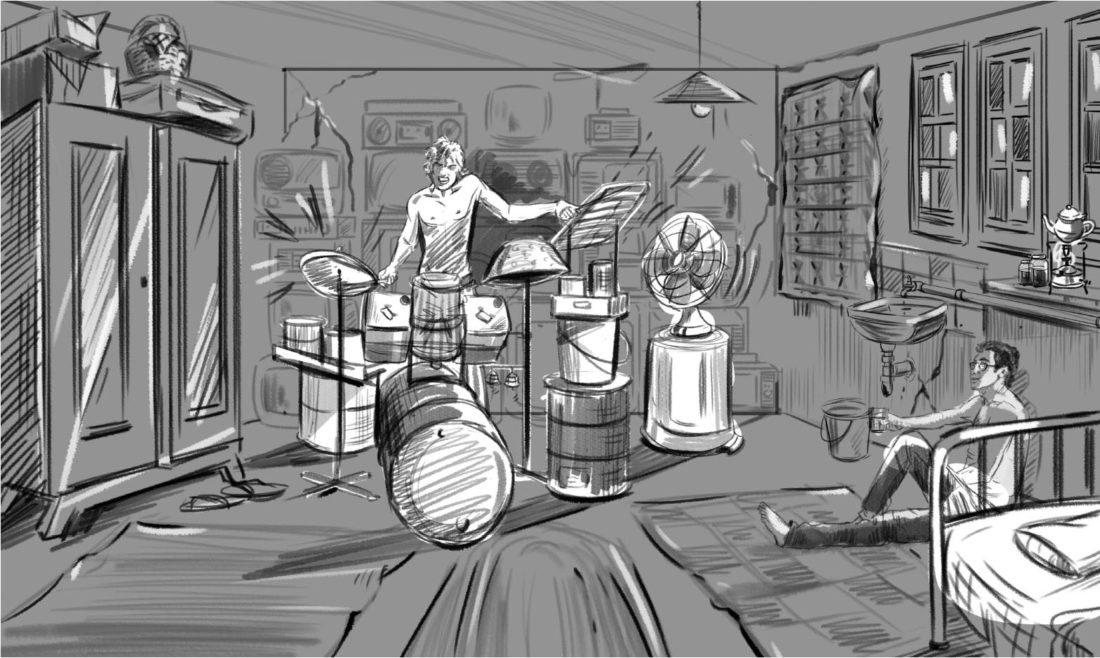
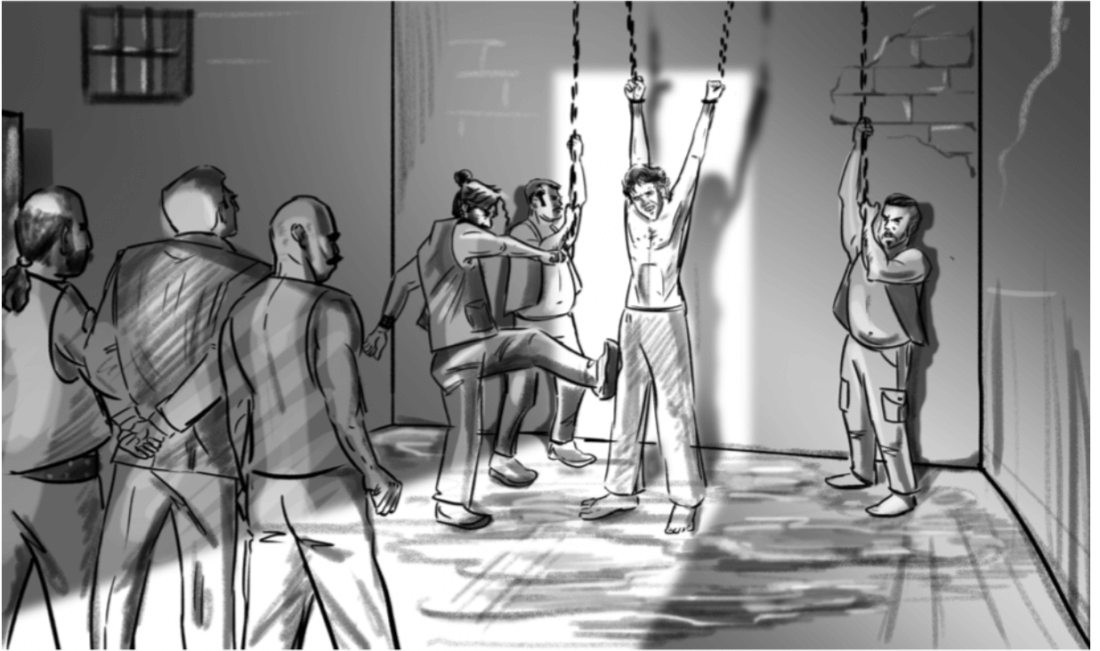
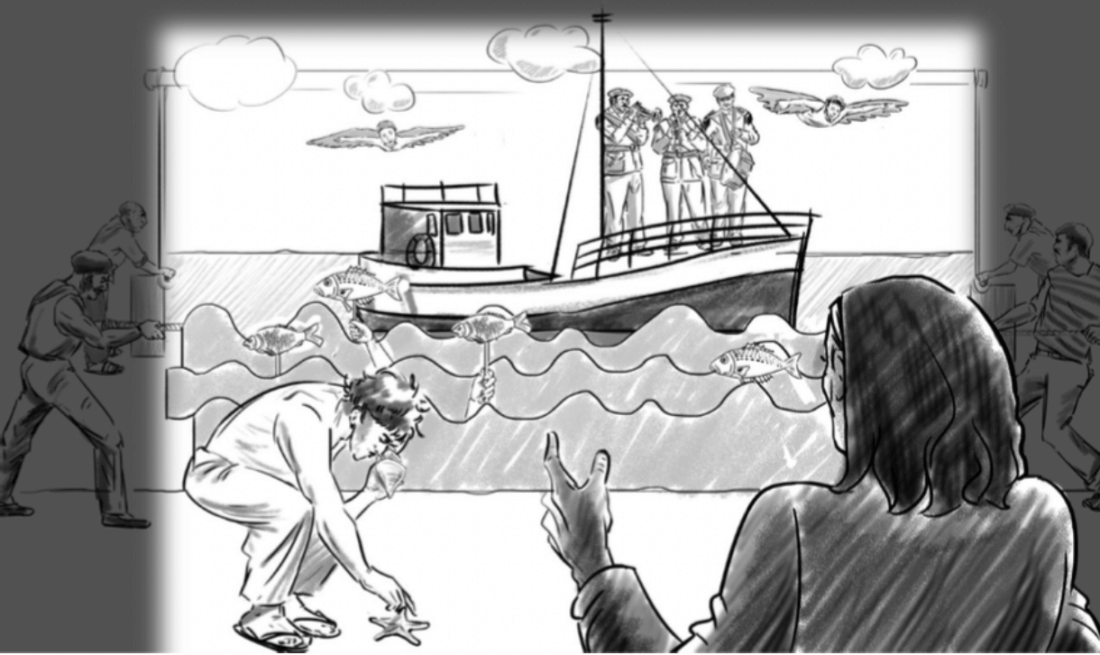
screenplay drawings East of Noon by Emann Salah
AK: Why did you choose to make the film with analogue stock?
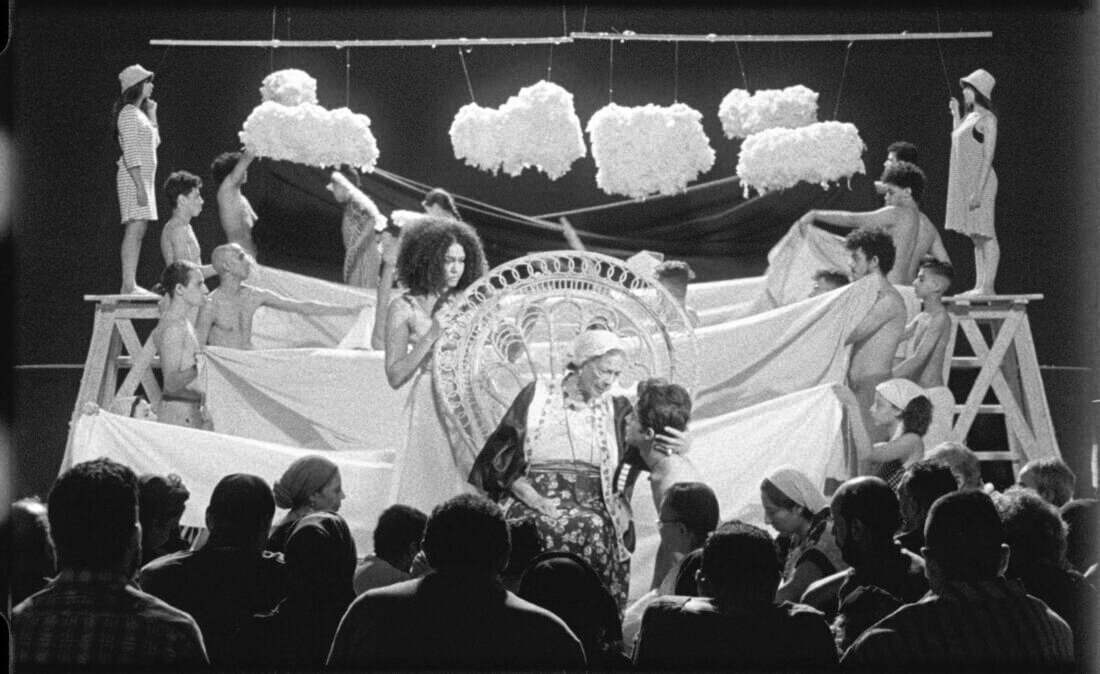
HE: Early in the script development, I had the idea that my film was made up of two worlds. One is the harsh reality, and the other is a lush fantasy. I shared this vision with my DOP, Abdelsalam Moussa, who is also my co-producer in Egypt. He told me: this film is impossible to produce. You’re creating this whole world with all these people in a closed place and it’s way too costly. I said no, you are wrong. I don’t intend to show this world with aerial views, wide shots, and lots of extras. I have just seen a short film by Agnes Varda that uses telephoto lenses in a crowded market, and I believe this is going to be my solution.
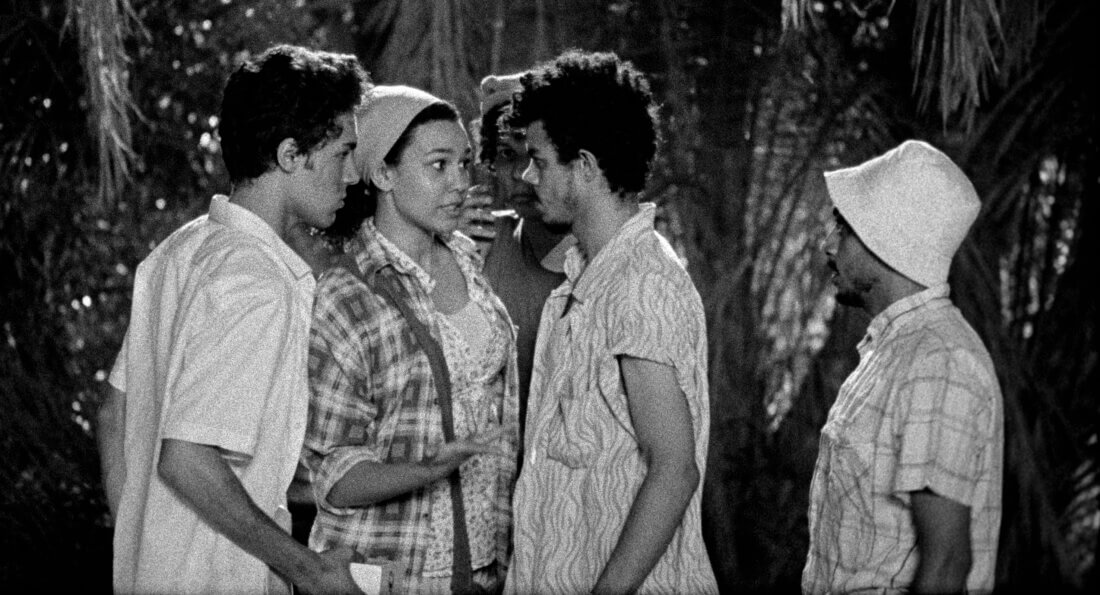
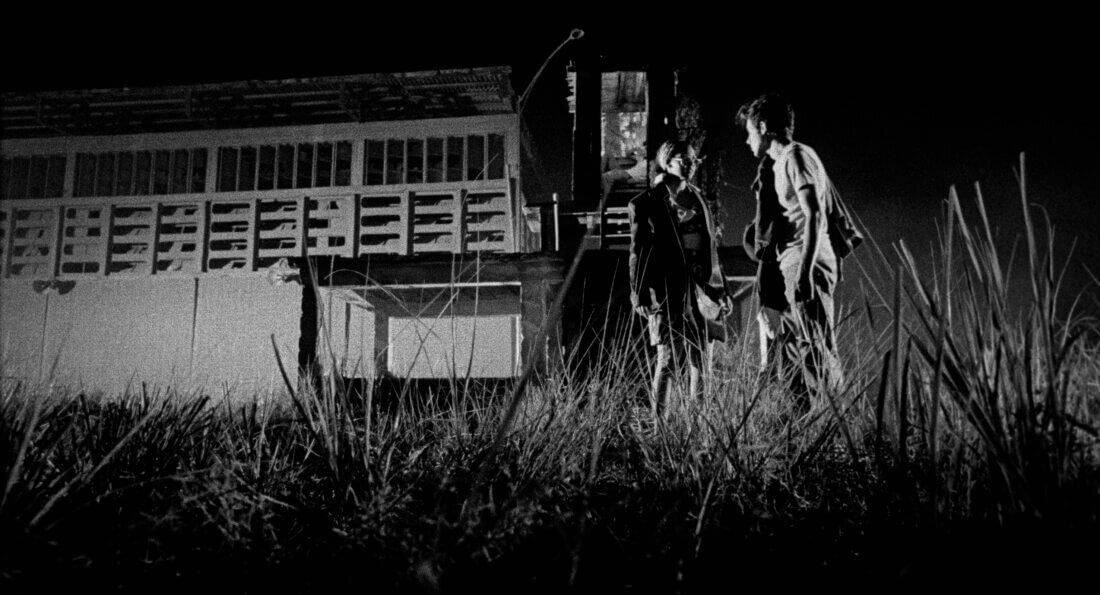
He watched the film and came back to me. And he said: the film was on 16 mm black and white. Are you telling me that you want to shoot on 16 mm? He loves film: he’s the one who shot the last analogue film in Egypt, eleven years ago, and he could not convince anyone else to do that. So then all of a sudden, the answer came my question of how to differentiate between the two worlds: black and white and colour. But I did not want the turning of the black and white to be a gimmick, so I worked with analogue film. And it also helped me strengthen the sense that the setting was not in a specific time or place. It’s possible that this dream was 20 years ago, or 50 years from now.
AK: Although the location of the film world is not identified, why did you want to shoot in Egypt?
HE: It could have been in another hot place, but the heat is important because of its contrast with the sea. Reality is everything that the sea is not. But I also have the benefit of knowing Egypt so well. For example, we started collecting the material that went into the sets a year before production. I figured out from previous productions that it’s cheaper than renting, and it allows you to sit with the materials and understand what you want to do with them. I stored it all in my flat. And every Sunday, we would go and fill a car of clothes at the market and sort them for the characters’ outfits. It’s a kind of guerrilla style of filmmaking. I can’t run a crew in the same way in Netherlands, it’s a completely different mindset. The world I’m filming in is similar to the world that I’m portraying. They share these affinities, and they work together.
AK: How do you bring your artistic experience with photography and installations into your films?
HE: When I made Cactus Flower, someone read the script and said: there is enough drama in here to leave out all these fantasy scenes. But I’m not interested in doing that. There are enough good filmmakers in the world who make dramas. If I don’t make film the way I want to, like an artist, then I am not interested. I will find the public that is willing to accept this. I bring my way of seeing, and my skills as an artist, but also the same concerns. I believe that the most important thing for an artist is to have some vision of a future, some ideal of the world. Artists are there to make people think about where they are and where they want to be.
To have this notion you need to know not just the moment you’re living, but also about the past. For a long time, I was concerned with the ways our history is lacking. Then I discovered the notion of history from below, which promotes learning about people from small stories rather than history books. In the big world that we live in, by trying to summarize and conclude we reduce so much knowledge. We carry around preconceptions and assumptions and everything is lost. So, my concern is with small stories. They don’t force you to take them seriously. But if you look inside, you find they are important. My interest has always been in stories that are not talked about, are forgotten, or are hidden by choice or by neglect. I try to look under the carpet.
AK: How has it been for you to be nominated for the Director’s Fortnight at Cannes?
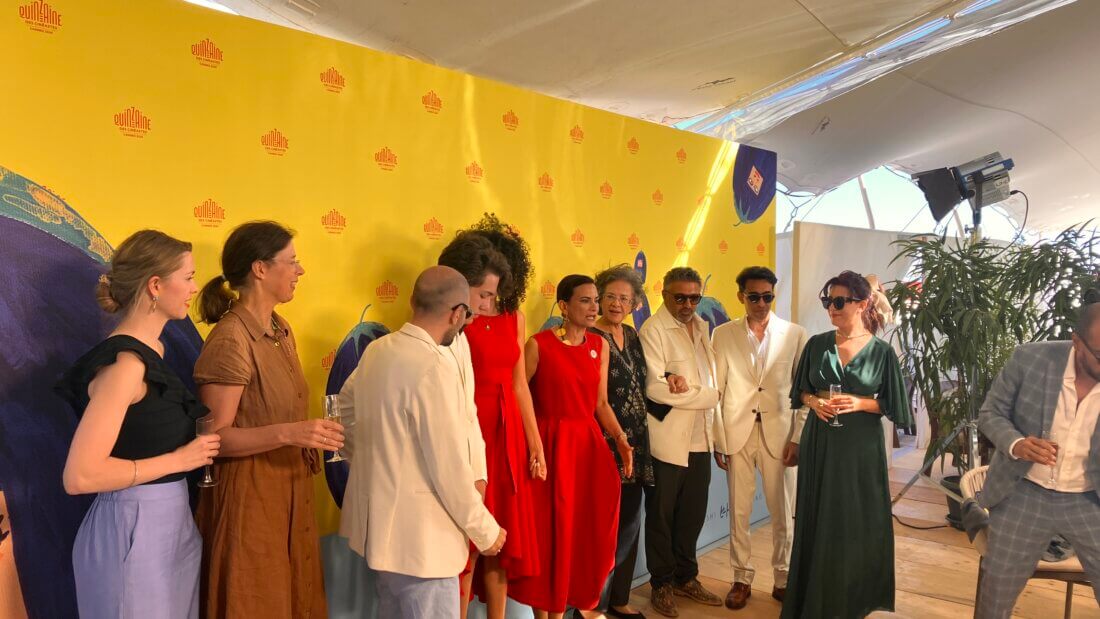
HE: I was told that for the Fortnight they look for directors who are not trying to address everyone, because a very particular vision can have more impact than a global one. I’m happy to be part of a program that sees my film for what it is. I am very happy to join this group of meaningful directors that are part of the program. Menha Batraoui, one of the lead actors, is now 78, and her first role on screen actually premiered at the Quinzaine des Réalisateurs 36 years ago. And she was not present then, so for her to be able to be there is also a great thing.
The two young leads, Omar Rozek and Fayza Shama, I promised that the first time the film is screened, I will pay for their way to the festival. They have been as far as the Gulf for work, but they have never seen a western country. It felt like the kind of reward that they would appreciate, at their age. It could change their lives, it could renew their belief in the fact that they want to make art, because for both of them, this is their first time on a cinema screen.
I spent the last 10 days trying to get visas for the Egyptian team to go to France. And I just realized that this is so much like my film. The world reflected in the film is closed on itself partly because it’s closed from outside. In the film, the characters want to get out and they need to find money to get out. And they risk dying if they go out. This was blown up in my face when I found out how difficult it would be to bring the actors to Cannes. I was treated with the utmost arrogance by the French authorities. In the middle of the process, I had to bribe to get an appointment. It’s very sad, but at the same time, I’m getting very stubborn. It became like a challenge, and I managed, to in the end, get to the press. They are now circulating a description of how I spent my time and how I was treated. I believe people deserve to be there, and you cannot just assume that you can look at their work, and not look at them. But I’m still fighting.
Astrid Korporaal is a writer, curator, programmer and researcher. She is completing a PhD at Kingston University on distributed authorship in film. https://astridkorporaal.com/