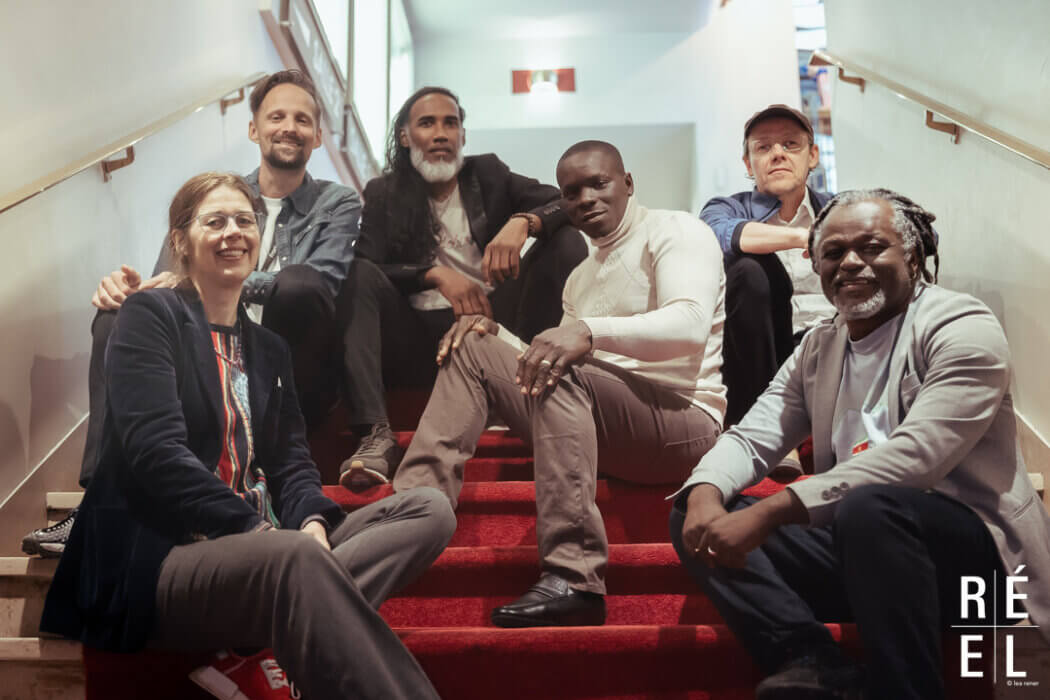


Jason Fox: Monikondee is the second film that the three of you made together in Suriname. How did your previous films lead to this collaboration?
Lonnie van Brummelen: When Dutch politics shifted drastically to the right around 2011, Siebren and I decided to make a film in Urk, a Dutch fishing village with a strong far-right populist presence. In this context, we opted to experiment with a participatory approach. We interviewed fishermen and used excerpts of verbatim transcripts to create the dialogue for a film script. These interviews were then re-enacted on camera by the fishermen themselves along with members of a local theatre group. In our film Episode of the Sea (2014), we combined these staged scenes with documentary footage of work at sea and scrolling titles, in which we reflect on our encounters with the fishermen. After editing, we organised a screening so we could show the participants the fruits of our collaboration.
Working within the Urk community was a transformative experience, and the film found both a local and an international audience. This encouraged us to continue exploring this approach.
Siebren de Haan: Our second participatory film, Dee Sitonu A Weti (Stones Have Laws, 2018), was made with the Saamaka Maroons in Suriname, a Dutch colony until 1975. One reason for making the film was that many people in our country seemed unaware of this colonial legacy and its repercussions in the present. We wanted to shed light on this history from a different angle. In Suriname we looked for collaborators from the Maroon community. When we met Tolin, we noticed that our storytelling approaches had a lot in common.
Tolin Alexander: We talked about the plays I had created in the interior of Suriname using methods from Augusto Boal’s “Theatre of the Oppressed.” These were site-specific productions I had created to address sensitive topics, such as safe sex and polygamy, and which allowed for open discussion. In these plays, community members were the actors. Through improvisation, we would stage recognizable situations. Then, we would encourage the audience to respond. When an audience member would suggest how an actor should have acted differently, the scene would be adjusted and performed again.
SdH: In Stones Have Laws, the Saamaka people share oral histories of their resistance to colonial rule. They recount how their ancestors escaped slavery and forged a new culture in the rainforest, drawing on African traditions and what they learned from Indigenous peoples.
LvB: Monikondee begins where Stones Have Laws leaves off, focussing on the resilience of communities that have to deal with disruption of cultures and ecosystems through capitalist interventions. Set in the Maroni River basin, along the border between Suriname and French Guiana, the film is situated in an area where gold and other resources have been extracted since the late 19th century.

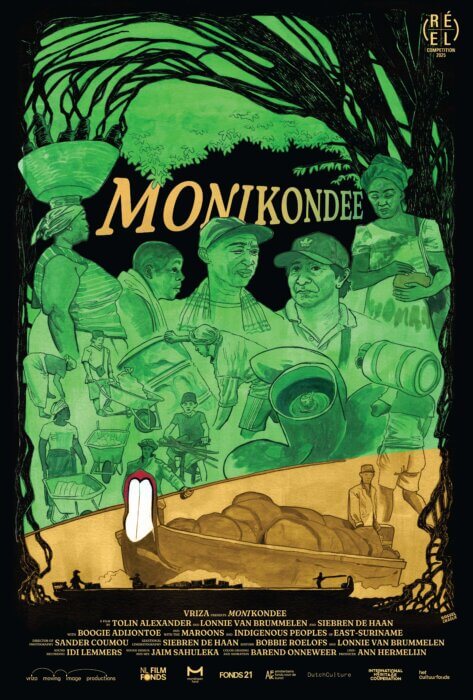
JF: What does collaboration and co-authorship mean for you?
SdH: Capitalist relations have saturated every aspect of our lives, including art and culture. Auteur cinema can be seen as a form of resistance against the profit driven approach of the film industry. The producer becomes less powerful, and the director reclaims its agency, gaining more space to act. But the risk is that the director is regarded as the sole author. Isn’t filmmaking a much more collective endeavor?
LvB: As artists and filmmakers, we’re indebted to others—crew members, fellow creators, people who entrust their stories to us. And that’s not even considering nonhumans, who also exert their influence.
TA: When I look at western society, it seems focused on claiming as much authorship as possible. In the west, something only exists if it is written down, or recorded. Written sources take precedence over oral sources. The west is accustomed to turning what is collectively owned into private property.
Like many Indigenous peoples, we Fiiman have to fight for collective land rights. Land is not considered individual property by our peoples. As a collective, we divide the land along matrilineal lines. People have belongings in our culture, but you are expected to share what you own when someone makes a request. Under the influence of Western culture, this is now changing.
JF: Can you talk about the challenges of collectively producing films within an environment that was once a Dutch colony?
LvB: We often heard from people living in Suriname’s interior that westerners will photograph or film them, without permission, and that they never see the results. That’s why many are wary of westerners, and especially ones with cameras. However, during the making of Monikondee, we didn’t really encounter such aversion. It’s probably because we didn’t immediately go into the communities with a camera, and because we worked as a team with people from Suriname, who were aware of these sensitivities.
TA: The project began with a long research period. We visited the different communities to discuss with people what they felt it was meaningful to contribute to the project. Based on these conversations, we created a provisional script. Then we went back to the communities and held kuutus (small village meetings) to discuss the script. Each community nominated the people they wanted to act in the film. Throughout the process, we encouraged the actors to interact with the camera.
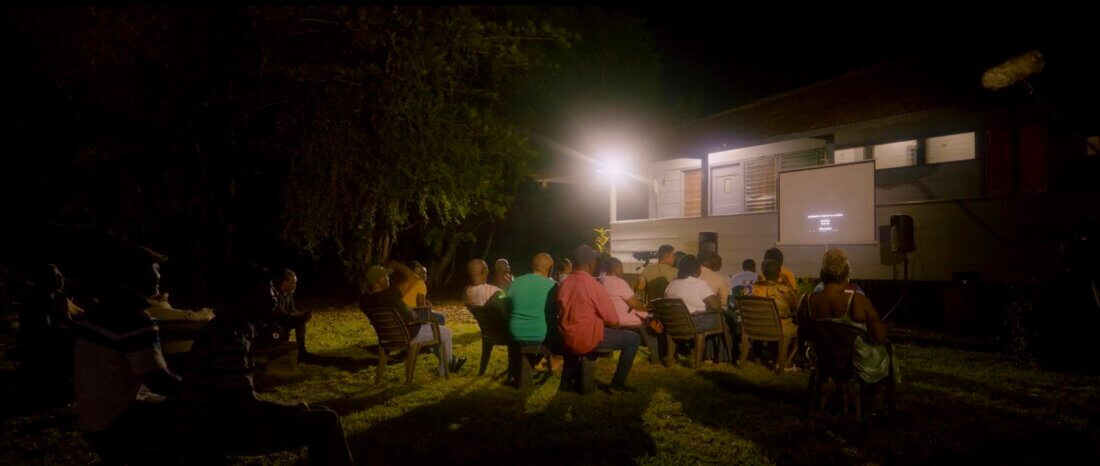
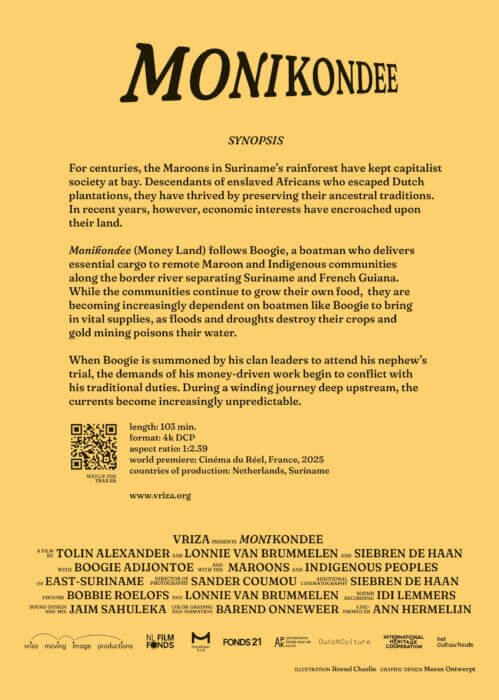
JF: Can you talk about the Mato tradition? What led you to apply this technique in Monikondee?
TA: Mato takes place in the evening and it is also an integral part of our death ceremonies. In the mato, a storyteller tells a story, but the audience can interrupt with their own storylines or songs at any time. The storyteller’s narrative then continues after the interruption. The stories that are shared can be folklore, fables, or personal experiences. People can fantasize about the future. Fiction is used to strengthen nonfiction. There’s room for creativity and everyone can contribute. Mato is an activity that connects the community.
LvB: We recognized in the mato a kind of Brechtian approach avant la lettre, a collective, interactive, and participatory practice which breaks the fourth wall. It’s an inclusive approach to storytelling, where anyone can participate by introducing alternative viewpoints.
TA: The layered nature of the story is emphasized by someone we call the “pikiman.” This person confirms and emphasizes what a storyteller says without interfering with the content.
SdH: As filmmakers, we were intrigued by the role of the pikiman, who contributes to the story by guiding the audience and maintaining its focus. We recognized in the role of the pikiman the function of the cinematic apparatus. Camera, sound, editing—these are all tools we use to engage the audience’s senses.
Jason Fox is a filmmaker, teacher, and editor based between New York and Toronto. He has taught in the Graduate School of Cinema Studies at New York University, Princeton University, Vassar College, and CUNY Hunter College. He is the founding editor of World Records, published with New York University’s Center for Media, Culture, and History.
JF: How do you approach the intersecting dynamics of local tradition, neocolonialism and contemporary capitalism in Monikondee?
SdH: We know that our ancestors brought plantation culture, slavery, and capitalism to Suriname. Through this ruthless regime, land, plants, and people were commodified.
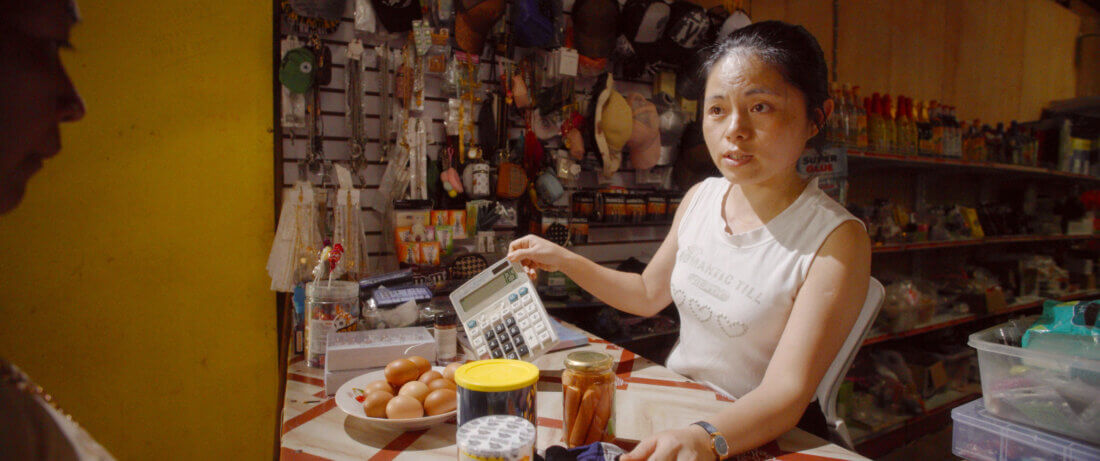
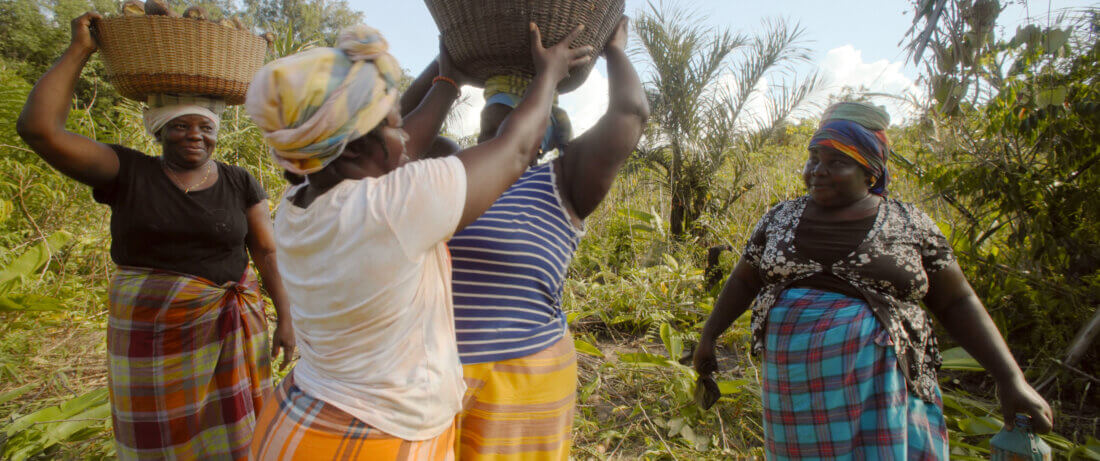
LvB: Maroons and Indigenous peoples lived until quite recently in societies where goods and services were not exchanged for money. They had other social systems to take care of themselves, such as barter, and pansu—the collective sharing of plant materials. The film Monikondee explores how these practices have transformed under the influence of the money system.
TA: Internationally, we are known as “Marrons,” but in our own language, we call ourselves “Fiiman.” Boatmen have traditionally served in Fiiman community as intermediaries. They brought the interior into contact with the more urbanized coastal plains, where the plantations were located and goods were for sale. Fiiman still call this area bakaakondee (land of the whites), or monikondee (money land). With the rise of freight transport, inequality also entered our community. Boatmen became wealthy. They were no longer committed to the collective society but instead focussed on their own commercial interests. In our society, you are considered antisocial if you don’t share your belongings with the community. In the past, you were even viewed as a witch. A practice emerged in which the priests of the Sweli oracle confiscated the possessions of deceased individuals who were believed to be witches. This practice was the community’s response to the disruption caused by the influx of money.
LvB: Today, the world is grappling with a climate crisis and division caused by profound inequality. What intrigued us about Tolin’s stories is that the Ndyuka people recognized these two dangers, and established institutions and customs to keep them in check.
TA: But all of these laws are now being violated. Less than a generation ago, Fiiman would spend weeks or months praying to nature gods. While they were praying, certain places were left undisturbed, which was good for our natural ecology. But now, the western time-is-money lifestyle has taken precedence.
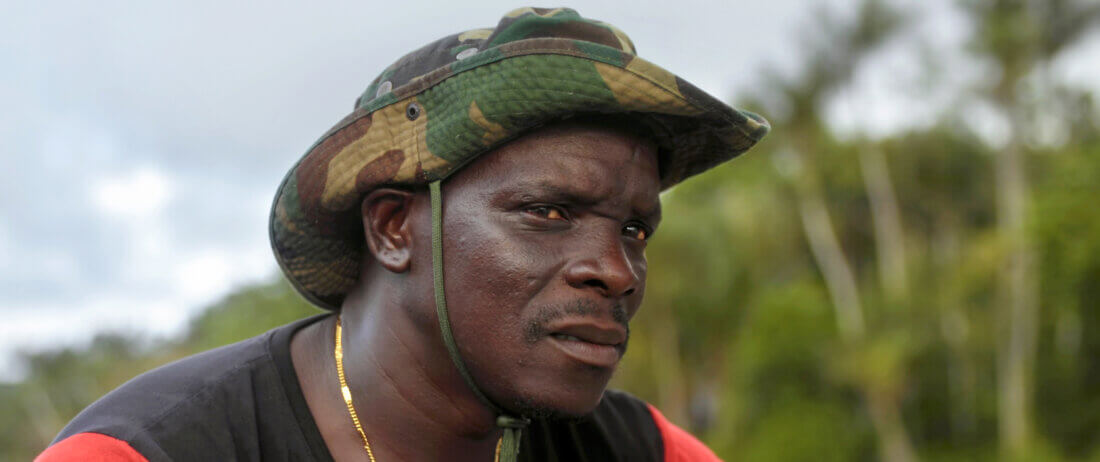
JF: How did you meet Boogie, whose journey along the Marowijne River gives structure to the film?
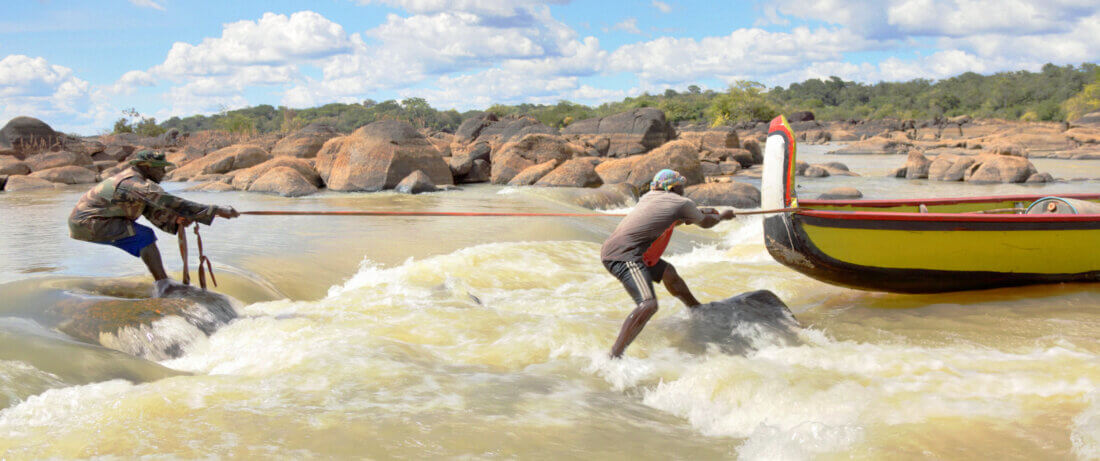
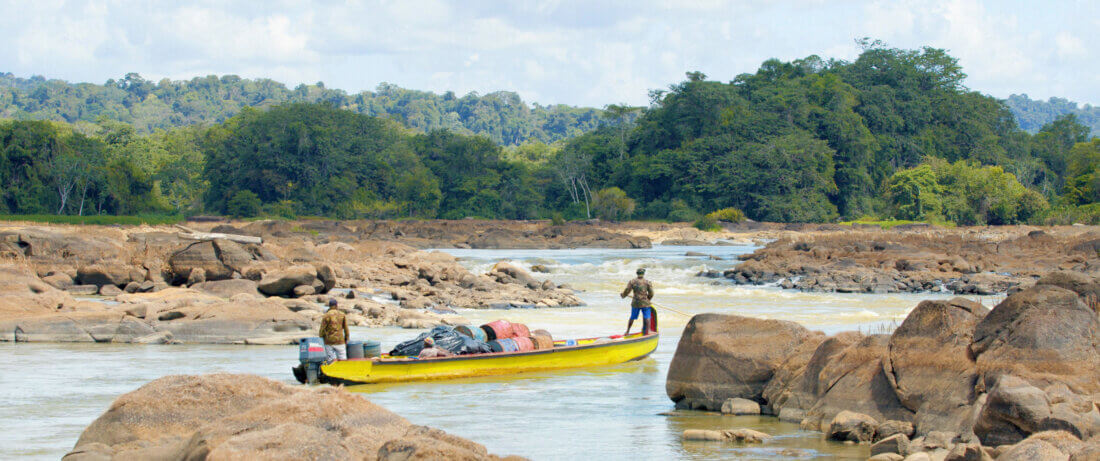
SdH: Anyone traveling to Suriname’s deep rainforest relies on boatmen. There are no roads, only waterways. We were familiar with these river trips from Stones Have Laws, albeit on a river less turbulent than the Maroni. When Tolin proposed to follow a boatman in the film, we were immediately enthusiastic, envisioning how a boat trip could take the camera’s eye to various river communities, through a labyrinth of rapids, rocks, islands, and creeks.
LvB: To scout for a boatman, we stayed in the border town of Albina for a few weeks, a harbor where boatmen frequently pick up cargo. It was here that we met Boogie. He builds his own boats, knows his history, and is proud of his Maroon culture. At the same time, he is a real entrepreneur who always has one foot in monikondee.
TA: Boogie is a true connector of the river. He comes from Bigiston, a village where Indigenous people and Maroons live together. Every month, he delivers oil to the Indigenous people in the mouth of the Maroni River. His father is Pamaka, and his mother Ndyuka. He’s Surinamese, but his wife is from French Guiana. She is Christian, while Boogie’s grandmother is a priestess in the Ndyuka spiritual tradition, which has many rituals to honor Mother Earth.
JF: How did your interest in making the natural environment a character in the film influence the formal choices you made during filming and later in post production?
SdH: The film is set on the Guiana Shield of Amazonia, a two-billion-year-old stone plateau covered by rainforest, where a labyrinth of rivers like the Orinoco and the Amazon carve their paths. One of its winding rivers, the Maroni, provides the film with continuity, flow, and rhythm. Boogie leads the viewer through unknown and undefined territory, both physically with his boat, and by infusing the story with his own river of thoughts.
LvB: Life in the rainforest is a constant struggle against the elements. There is no connection to the power grid, no running water, and no road network. It takes great physical effort to transport things in the scorching heat, across uneven terrain. During filming, we aimed to transport viewers into this reality. We tried to make tangible the delicate balance between the people and the forces of nature by using a travelling camera that accompanies the people as they move, work, bargain and deliberate.
SdH: Therefore we chose not to use drone shots. No “view from above,” but rather a “terrestrial perspective,” as Bruno Latour puts it.
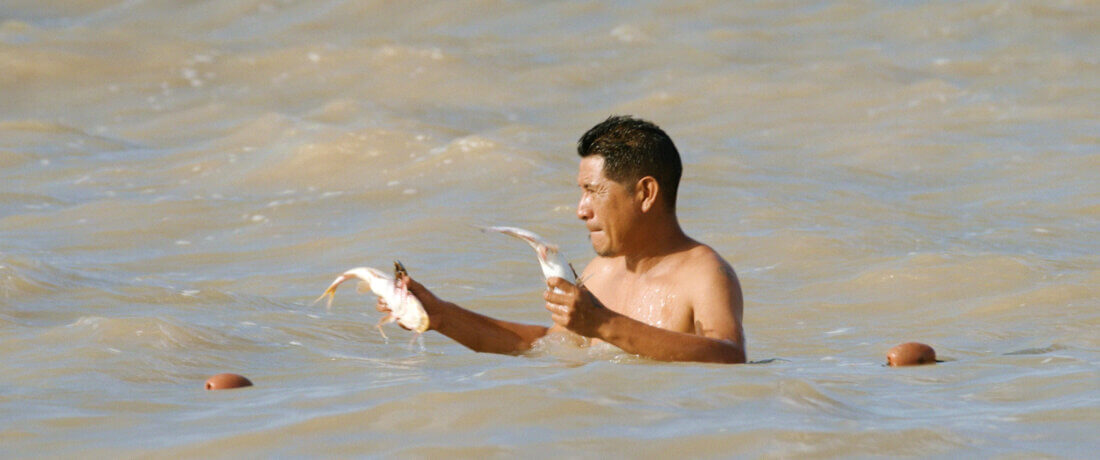
LvB: During both the filming and the editing process, the river gradually became a character with its own unpredictable nature. Its colors shifted, growing bluer as it neared the sea, redder or yellower near the gold mines, and browner—or even blacker—under the forest canopy, due to the sunken leaves. The river carried the boatmen and their cargo, but it also held them back when the currents were too strong, or when the water level dropped due to the relentless drought, halting both their journey and ours.
TA: The river tells us something about itself. When you see the water becoming yellow or red near gold mines, that’s the river telling us what humans do to it.