

Astrid Korporaal: What was the starting point for the film? Was it a particular place or question?
Jasper Coppes: In my last film, Aasivissuit (2019), I became interested in the rock dust that flows out of the glaciers in Greenland. I learned that Greenlandic rock dust can be used as nutrient to improve poor soil, because it contains minerals and can help capture CO2 in the soil. But then I saw a news item on Dutch TV showing that a large amount of rock dust had been dumped in a lake in the Netherlands, which was causing environmental damage. It triggered my interest: what in one place was perceived as having a lot of potential, is seen as waste in another context. When I visited the site, I learned that the dumping was part of a rewilding project to make these lakes more biodiverse. But how can dumping waste lead to biodiversity?

AK: What is the importance of narrative versus atmosphere in the work?
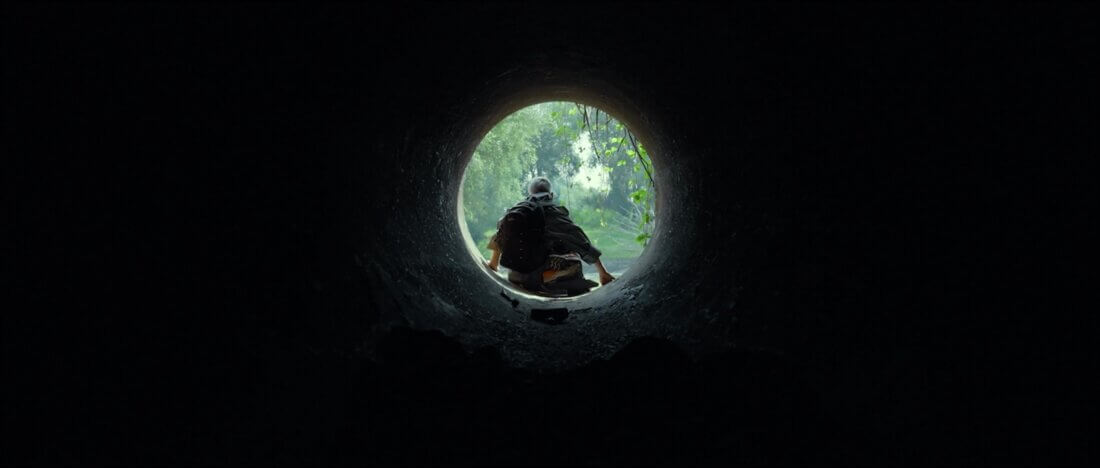
JC: The film is composed of two parts. The first part could be called a counter-narrative to the story told by the authorities. Here, the film stays close to the images the companies produce to convince people that making new nature with contaminated soil is a good idea. They have a particular kind of slick, optimistic, lush and vibrant way of showing nature, with lots of flowers and green. But the narrator reveals what the authorities try to hide: that everything we see and hear is living on contaminated soil. The story ends with a question that directs your attention back to the landscape itself.
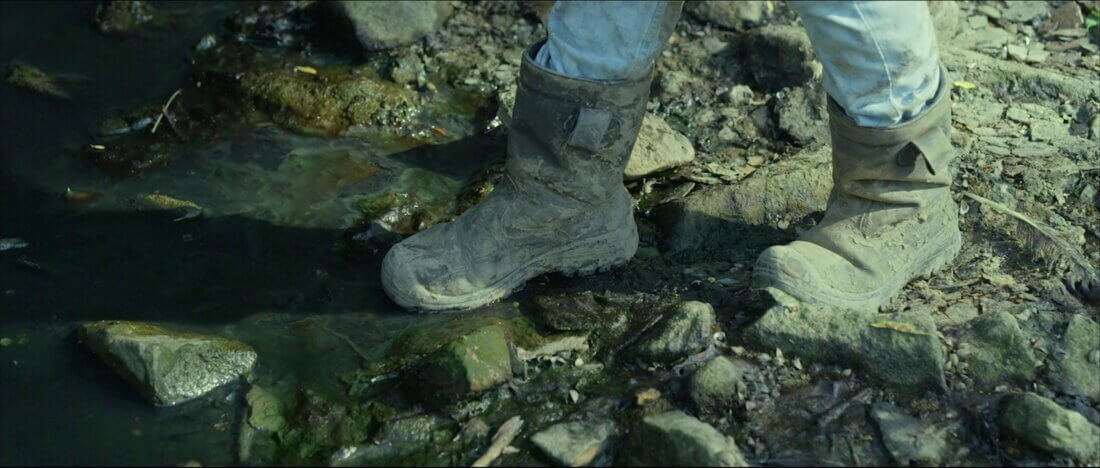
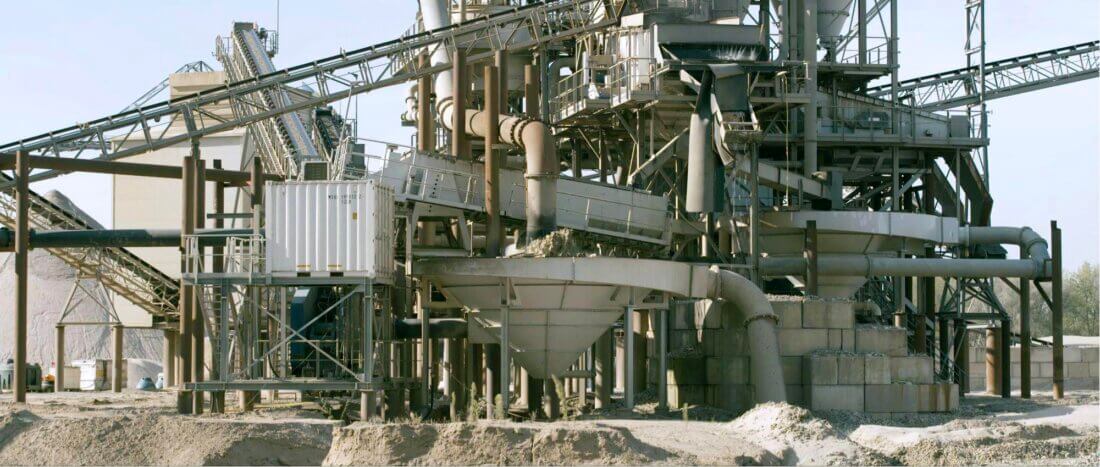
The view I came to with the new participants is that the landscape we were filming is a hybrid. It’s both industrial and ecological. It’s both self-regulating and manipulated. The cows that you see have been bred to look like ancient cows. In that sense they are already cinematic. They are designed to become a kind of audio-visual experience, catered to human ideas of wilderness. The film aims to show that human need and human construct. I wanted to emphasize that, like the cows, the landscape has been manipulated to look like a primordial nature, like the most authentic nature, but in fact it is shaped by industrial forces. The horses are chewing grass right next to a sand-mining machine. The beaver drags itself through contaminated mud.
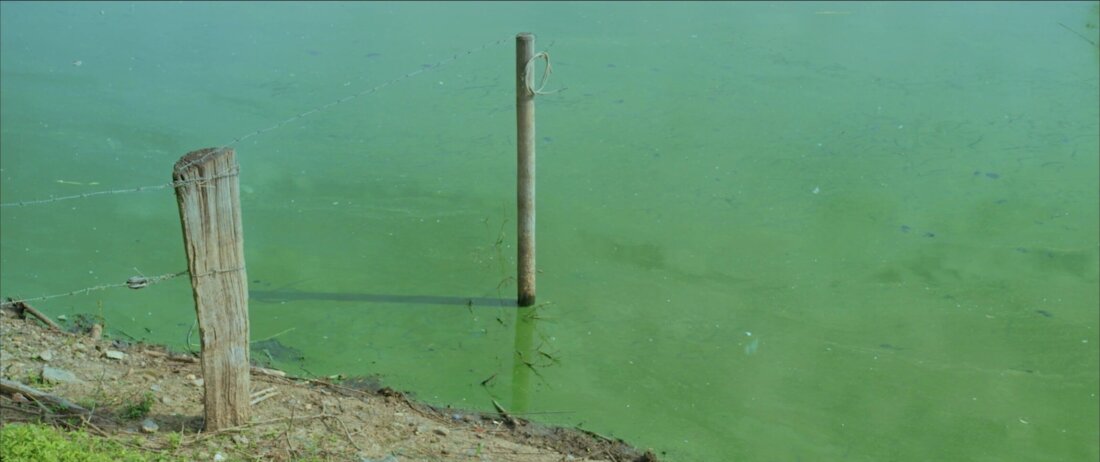
In the second part of the film these aspects of the landscape become more palpable through the combination of image and sound, to a degree that they become a bit yucky. What first seemed lush and vibrant green becomes a disconcerting green slurry. Sounds from the all-pervasive industry, machines, cars, and planes constantly encroach upon the peaceful scenery.
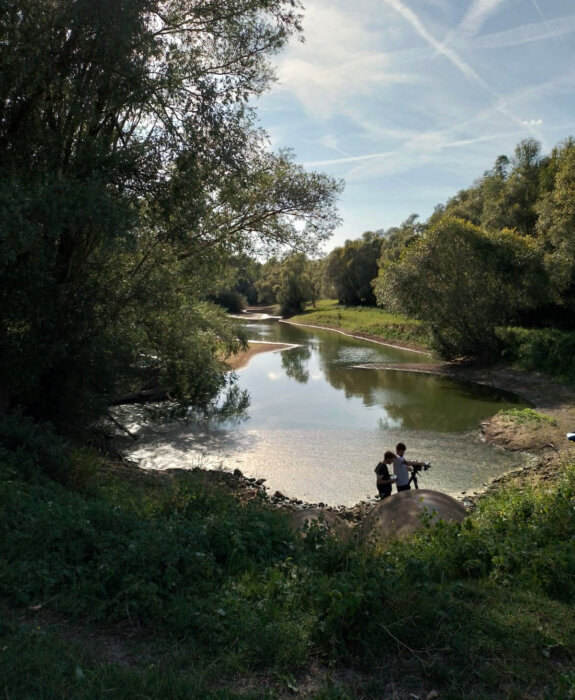
Jasper Coppes and cinematographer Casper Brink during the shoot in the nature reserve, 2022
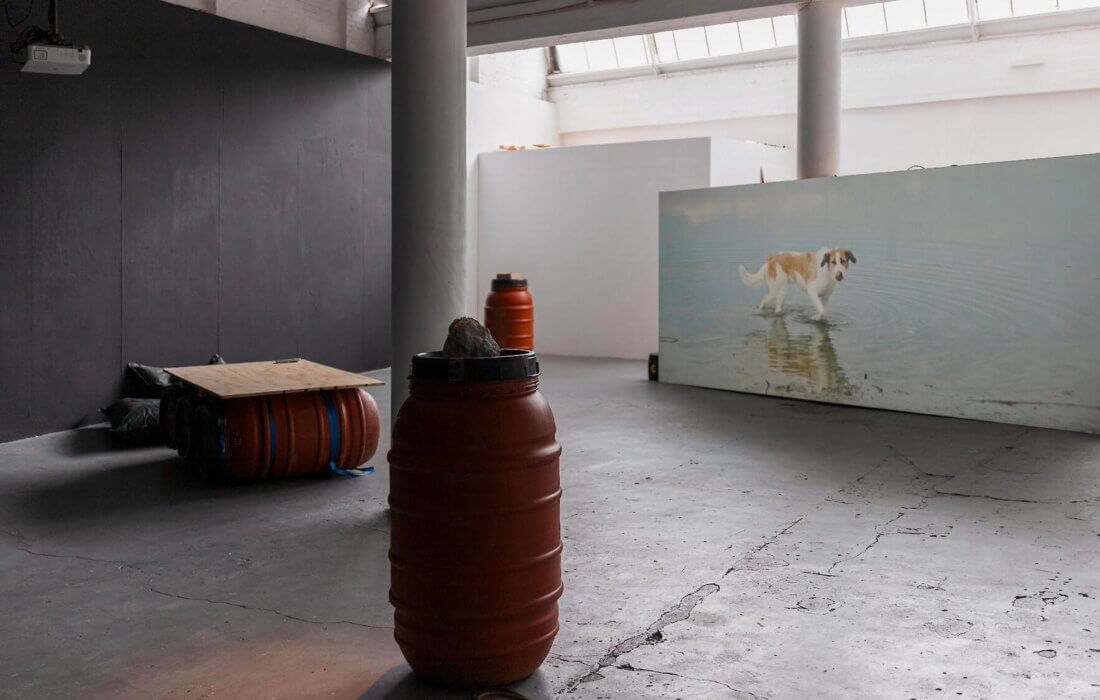
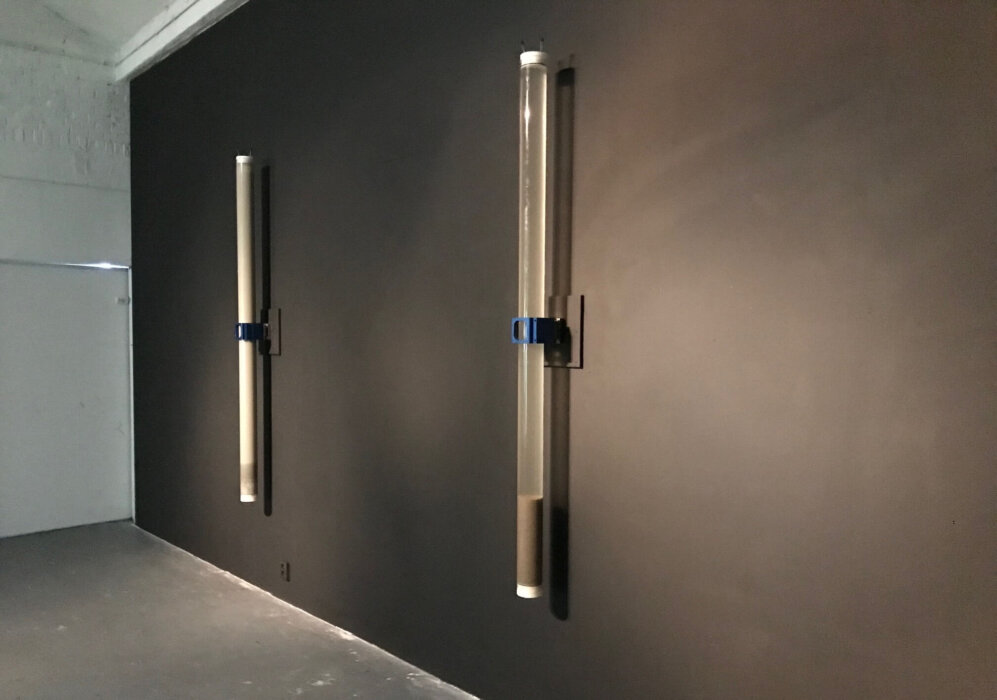
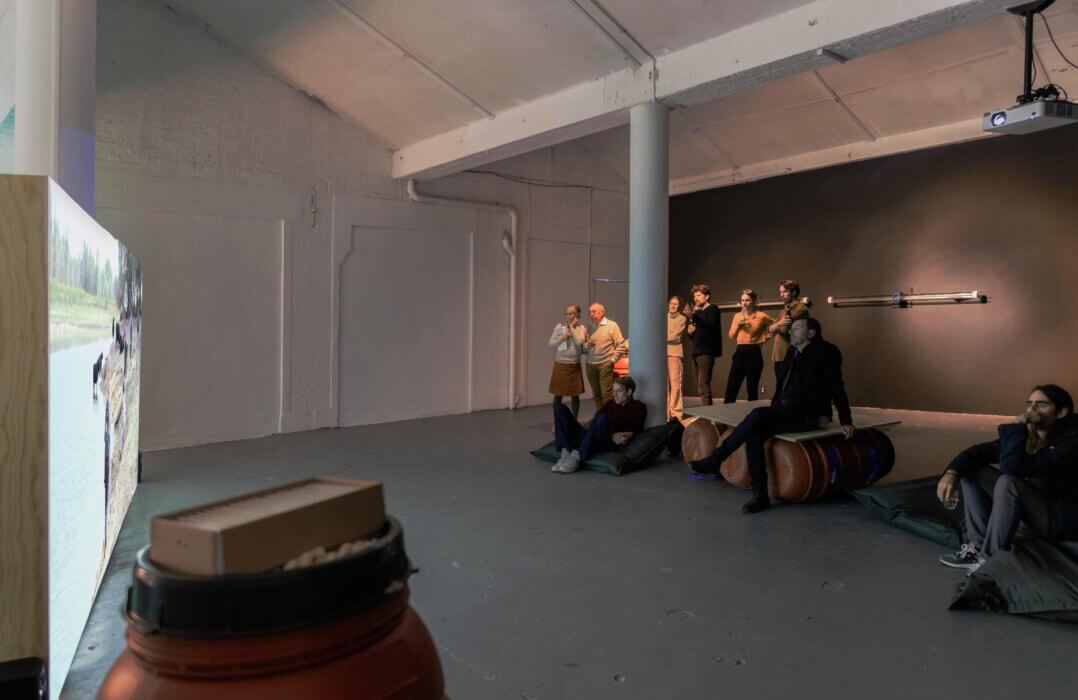
Presentation of research for KALI WAAL in solo-exhibition Fragments from Shallow Lake, P—OST, Nijmegen, 2022
Alongside other research materials, the exhibition at P—OST presented scenes from the first film shoot. A group of actors met at the controversial lake to share their own experiences and memories of contaminated nature from their personal memories. These reflections were paired with footage of the contaminated lake. The exhibition provided an opportunity to reflect on the process of editing. Local inhabitants, schools and other practitioners such as Platform Dis, designer Billie van Katwijk and environmental scientist Daniil Scheifes were invited to present their perspectives within the context of the exhibition.
In collaboration with geoscientist and artist Esmee Geerken, two large test tubes were developed at research lab AMOLF, to show that one of the dumped substances continuously muddles the lake water. Geerken was an important collaborator during the preliminary research of the film, and a participant in the eventual film recordings of Kali Waal.
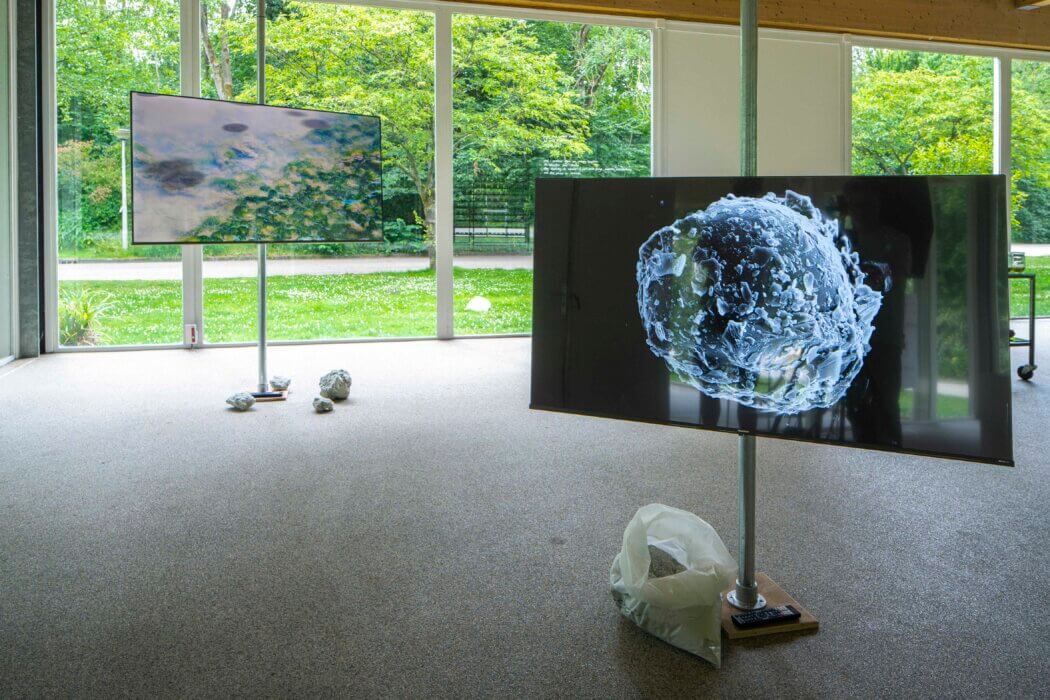
Presentation of research by Jasper Coppes in collaboration with Esmee Geerken in group exhibition Our Living Soil, at Zone2Source, Amsterdam, 2022
AK: Ecological questions play a role in many of your works. How do you see your role as an artist or filmmaker in relation to these questions?
JC: I’m interested in places where the ecology is disturbed: where humans have controversial relationships to nature. More specifically, I’m fascinated by the kinds of narratives that are developed around nature reserves. Those can range from being very romantic about the potential of rewilding to industrial narratives that revolve around efficiency, economic wealth, and progress. The landscape then sits in the middle of these often opposing narratives. I see my role as someone who can raise awareness around the impact that these narratives have on the environment, and at the same time redirect our attention to the landscape itself.
AK: Could you say something about the film’s narrator? And the title?
JC: The title Kali Waal refers to a lake that has a long history of being a toxic dump as well as a rewilding project. It’s a kind of blueprint for the idea that upgrading nature can be both poison and cure, but of course there are more lakes that are subject to the same approach. The narrator is one of the researchers in the group you see in the film.
The group of researchers tell the story of the local inhabitants, and because they do not live there themselves, they can ask new questions. I find this “outsider” perspective important, because what we do with our waste is an international concern. In the Netherlands, the burden of our waste is generally outsourced to other countries, but some of the waste that was dumped in the lakes was illegally imported from abroad. The title reflects this ambivalence. In Greek, the language of the narrator, Kali means “good”. In Sanskrit it refers to the goddess of destruction. In Dutch it could refer to the mineral potassium. The word Waal is of Germanic origin (Old Germanic: wôh = crooked) and refers to the many twists and turns of the nearby river.
AK: Do you see the work as giving the landscape or non-human subjects a voice?
JC: As an artist, my primary concern is to raise the question: what is the will of the landscape? What is the agency of the non-human inhabitants amidst the stories we tell about them? Each film that I have worked on in the past years, develops a different answer to that question what the agency of the landscape could be. Flow Country (2017) explored the historical layers of a remote peat bog. How can film read those layers, and what is created from this reading? Aasivissuit (2020) added new perspectives to the narrative that people outside of Greenland have about Greenland’s changing landscape, by bringing in embodied experiences from the people that live there, and from non-human entities inhabiting the landscape: birds, ice, microbes. In Kali Waal, the intention was not to speak for the landscape, but to counter the narrative being spread by industries, companies, and governments: that we can create nature with contaminated soil and pretend that the result is a kind of unspoiled wilderness. I wanted to rewrite that story.
AK: How do you balance documentary and fiction in the film?
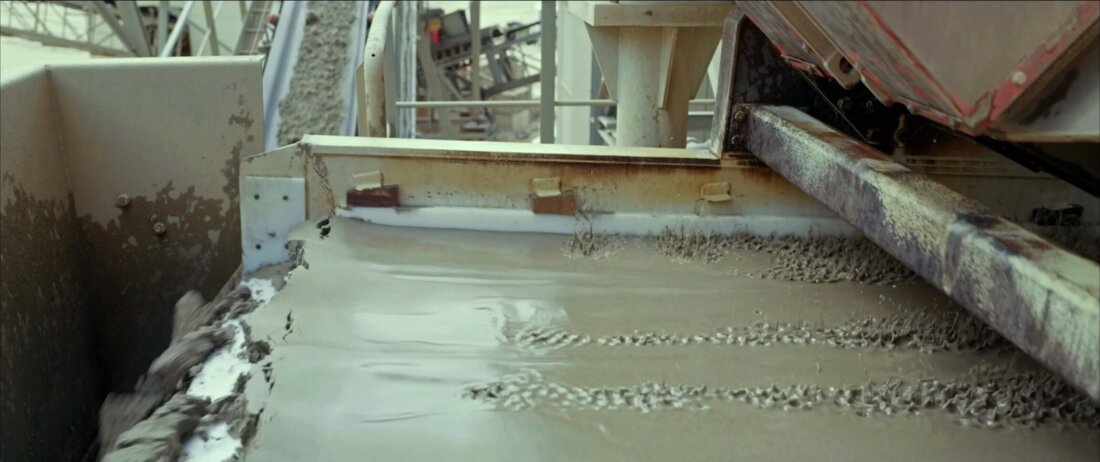
JC: The starting point for the film was not fiction, but a real situation. The rivers Waal and Maas in the Netherlands are polluted by industrial waste from all over Europe. Instead of making an effort to clean the waters and regulate this ecological impact, our government thought it was a good idea to just go along with the contamination. They made a law in 2007 that enabled the use of contaminated river sludge in rewilding projects around sand-mining pits. It turned out that no-one was monitoring how toxic that sludge actually was. This opened the door for companies to import highly contaminated waste from abroad and add that to the mix that was thrown into the sand-irrigated lakes.
My initial plan was to collaborate with local inhabitants who live near the contaminated lakes. They seemed eager to share their concerns. However, when the controversy was gathering attention in the media, these local activists were threatened by the companies involved in dumping waste. In result, several of them pulled out of my film project. So, I decided to put out an open call to interested, non-professional actors from elsewhere. A group of artists, choreographers and performers responded. They brought many new perspectives to the controversy. They helped me to see an opportunity to fictionalize the narrative, working with the idea that fiction can be a form of resistance to the dominant narratives. In the end this group became contributors as well as actors.
The group took on the role of researchers who come to investigate what is happening in and around the lake. Acting as visiting researchers, they encounter the story of the local inhabitants. Initially, my plan was to push the narrative towards science fiction, because as a storytelling tradition it is useful for offering critique of dominant structures and dominant narratives. But the story we tell is not really about the future, it’s about the present. So, it’s more like a ‘near-fiction’, alongside reality. This is a term I ran into in Elvia Wilk’s book Death by Landscape (2022). She proposes the idea that near-fiction can be a productive form of speculation. Wilk also emphasizes that in storytelling the landscape is usually a backdrop, and she proposes that we foreground it instead – a proposal I really appreciate.
AK: What do you want the audience to take away from the film? Should we form different relationships with the landscape?
JC: The promise of the authorities is that by manipulating the landscape with economic forces, it will become more biodiverse. The way I see it is that the film expands the idea of biodiversity beyond this opportunistic framework.
In the Netherlands we have such an incredibly long history of shaping our environment to our needs and desires. It’s very deeply ingrained in the Dutch consciousness, looking at nature as part of something you can adjust and improve. I think it’s also typically Dutch to be pragmatic about it, and to see the economic gain.
The film proposes that one way to bring back life is to diversify our storytelling, as well as the way we construct the depiction of nature. Even though we filmed digitally this time, I still see the process of making a film as an alchemical process, mixing sounds and images in a particular way to create something new. By bringing more ingredients to the mix, we can move beyond the idea that we are in control. We can learn to surrender to a more complex reality.
Astrid Korporaal is a writer, curator, programmer and researcher. She is completing a PhD at Kingston University on distributed authorship in film. https://astridkorporaal.com/
CONTEXT
Zembla wint hoger beroep, Parool, 28 May 2024
Zembla wint rechtszaak, NPO, 28 May 2024
EXHIBITIONS
Our Living Soil, Zone2Source, 10 July – 18 September 2022
Fragments from Shallow Lake, P—OST Nijmegen, 14 November – 11 December 2022
REVIEWS
MetropolisM, 2022
De Brug, 2022